
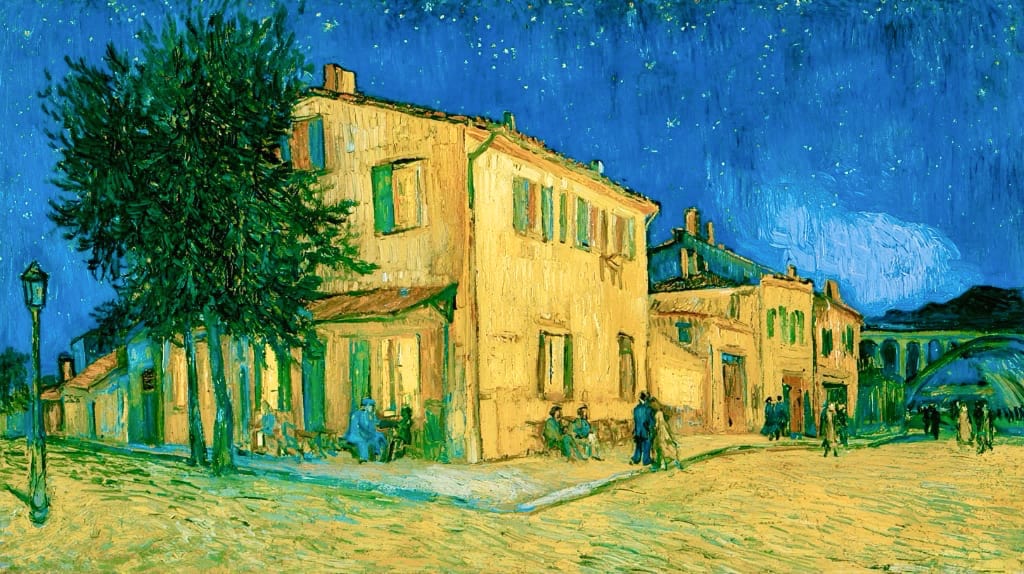
Liturgy for a Starry Night, Part 12.1, Arles, Spring 1836
(where beauty is the last thing left that belongs to us)
I. The Yellow House
It sits on the corner,
mustard yellow, warm to the eye,
a promise of shelter
that the nose immediately contradicts.
Damp plaster. Fried onion.
Lingering acrid smoke from fires
that never fully caught.
This is Arles.
This is 1836.
This is what hope looks like
when it rents rooms
in a house that will one day
hold Van Gogh’s ear
and the echo of his screaming stars.
But Brigid does not know that.
She only knows
that the house is warm to the eye
and cold to the touch,
like everything in Arles,
like everything in this age,
like the thinness of law.
II. The Neighbourhood of Careful Vowels
The neighbourhood speaks Italian,
but softly,
with careful vowels,
as if the language itself
might be a crime.
The local doctor refuses them:
“I only treat our own kind.”
And so shame turns practical.
Children cough,
coins are few,
and Brigid’s hands become the pharmacy
for those the law has learned to ignore.
This is how resistance begins:
not with pamphlets
or marches.
It’s with a stitch
where no doctor will sew,
with a cure
where no medicine is sold,
with a woman
who remembers
that healing is not a kindness,
it is a weapon.
III. The Rope Burns on His Hands
Felreil works the docks.
Rope burns on his palms,
maps of a labour
that will not make him rich,
will not make him safe,
will not make him visible
to those who write the laws.
But there he learns
that police keep the peace
by pressing the lid on the pot.
He brings home a pamphlet called
“What Is Property?”
and lays it on the table
like a second supper.
“This,” he says,
“will set feet marching.”
Brigid reads it by candlelight
and feels the old, familiar stirring;
the knowledge that some questions
are themselves a form of treason.
IV. The Stars Sharp as Nails
That night, they sit outside.
The air has cooled.
The frying onions have stopped.
And the stars
are sharp as nails,
each one a point of light
driven into the dark
like a promise that cannot be revoked.
Brigid looks up
and remembers:
there is a world above this one
that does not ask her accent,
does not check her papers,
does not care
what the pamphlet says.
She says,
“A starry, starry night,
beauty is sometimes the last thing left
that belongs to us.”
Felreil does not answer.
He does not need to.
His silence is a prayer
to the same sharp stars.
V. The Last Thing Left
Beauty is not a luxury.
Beauty is not a distraction.
Beauty is not something you turn to
only when the belly is full
and the law is kind.
Beauty is survival.
The last thing left
when everything else has been taken.
The yellow house may smell of damp,
but it catches the evening light
like a candle in a window.
The stars may be sharp as nails,
but they are also beautiful,
a reminder that the universe
does not consult the local doctor
before deciding to shine.
Brigid teaches this
without teaching it at all,
that to notice beauty
in the midst of threat
is not naivety.
It is defiance.
It is the soul’s way of saying:
You may take my wages,
my rights, my safety, my name,
but you will not take the stars.
Look up.
The stars are still there.
They have outlasted every pamphlet,
every doctor,
every threat to press the lid on the pot.
They will outlast this too.
And so will Brigid and Felreil.
A worksheet/mindmap for this week’s Six Sentence Story, prompt word ‘table‘. All previous Liturgies are here. Some images created with Midjourney; all writing is my own original work.©Misky 2006-2026.


Your comments are always welcome