25 May: The Liturgy for Accents

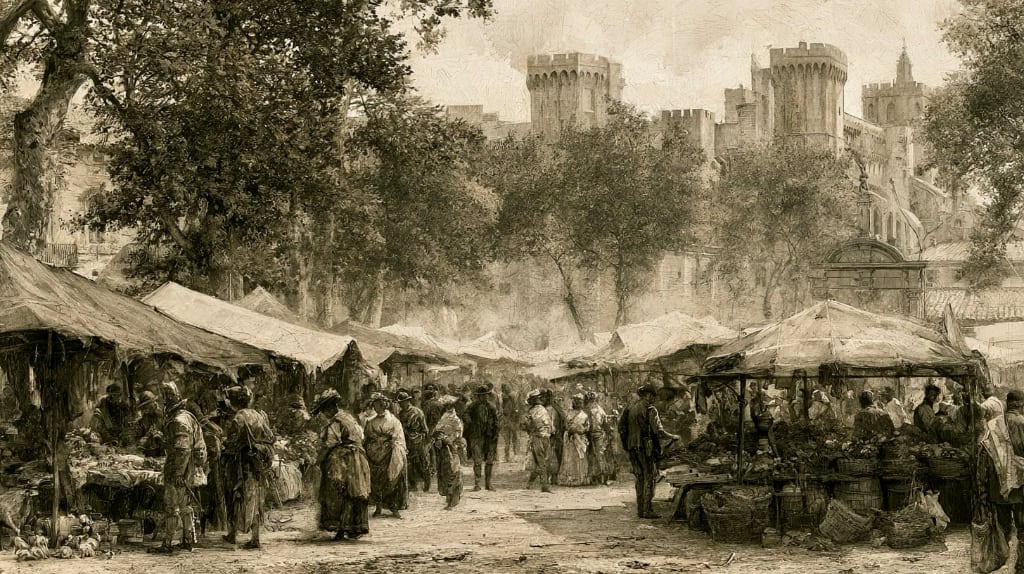
monochrome image of Avignon market during mid-1800s

Part 11.2, Avignon, 1836: Liturgy for Accents That Betray
Where the crowd turns on a syllable

I. The Unforgivable Difference
Sometimes —
it is how you say it.

The foreign curl of a vowel,
a rhythm
learned elsewhere.

Brigid’s accent rises like smoke
above the herbs,
the ointments

like smoke from a fire
no one sees.

She asks
for chamomile,
for arnica,
for small remedies for strangers.

But accents speak:
I am not from here.

Belonging
is the only currency
some crowds accept.

II. The Accusation of “Foreigner”

The word strikes
like stone in still water.

The crowd shifts,
rearranges itself around difference.

“She stirs rebellion!”

But Brigid
is holding lavender.
Accusation
has its own hunger.

This is how crowds turn:
a word
finding a fault line
in an empty belly,
a face
for fear to wear.

III. The Knife at the Belt
Felreil stands behind her.

His hand moves.
Not to her arm,
but to the knife
between belt and pocket.

The gesture says enough:
we will not go quietly.

Avignon’s walls
offer no mercy.
Palace bells,
hollow with grandeur.

The crowd tightens.

Brigid’s accent hangs there,
a verdict
without trial.

IV. The Witnesses
A woman makes
the sign of the cross,

protection,
not piety,
as if an accent
were plague.

A pear falls
to the ground.

No one picks it up.

In a town
where hunger
is arithmetic,
even waste
becomes accusation.

A child stares.

Perhaps
the most dangerous witness,
because children remember.

V. For the Marked
Keep the accent
that betrays you,

and may it be
the only interest
they have.

Hold the hand
on the knife
not yet drawn,

and may it remain
a warning.

See the woman
who crosses herself.

May her fear
find a kinder target
than a stranger
buying lavender.

See the pear
on the ground:

may it feed someone
who has forgotten
what hunger tastes like.

And watch the child
who watches,

may they learn
to question
why a foreign voice
is a crime.

The crowd will turn.
Crowds always do.

But, keep walking.
Keep your accent
like a flag
you refuse to lower.

Foreigner
is not accusation.
It is geography.

It is the map
of everywhere
you have survived.


Written as a worksheet and mind-map for Written for Denise’s Six Sentence Story including the word “interest”.  All previous Liturgies are here. Some images created with Midjourney; all writing is my own original work.©Misky 2006-2026.

11 responses to “25 May: The Liturgy for Accents”

  1. This speaks of such a sad state of affairs. We are living it- most likely always have been and I just chose not to notice.

    Liked by 1 person

    1. It does, it explores the tension of scapegoating — especially because it leaves room for the exceptions, the witnesses, the child who might learn differently. I do try, Jodi, not to leave the reader exhausted by it. And thanks for leaving your very thoughtful comment. (smiling) 

      Liked by 1 person

  2. not for nothin’ but (from the Doctrine’s perspective)

    Belonging
    is the only currency
    some crowds accept

    Amended to all rather than some, manifests both as praise and condemnation

    Liked by 1 person

    1. Thank you for that, Clark, and not to contradict the Doctrine, which I enjoy — I chose “some” deliberately. Anthropology deals in patterns and tendencies, not human absolutes; “all” would flatten the very social variation the poem is examining.

      Like

  3. I was once complimented – in English, but in Normandy – that my French was very good. I gave up at that point!

    Liked by 1 person

    1. That made me chuckle. Assumptions, eh? I was near Moorfields last week when a couple approached me asking for directions to St Catherine’s Dock, and when they heard my accent, they peeled back and apologised for bothering me. Gosh I laughed, while giving them directions.

      Liked by 1 person

  4. “…a verdict
    without trial”
    And even if there was one, a mockery of the process.
    Over 60,000 executed between 1400 to 1775, 3/4 women.

    Theories attempt to rationalize and categorize human behavior. Irrelevant.
    Everyone is capable of the best, the worst and the unexpected. Through Choice.
    It is self evident that we haven’t evolved as species: public executions observed as spectacles then. Same thing now – only through the screen of a mobile phone while chewing a Big Mac.

    A potent mirror this Liturgy, Marilyn.

    Liked by 1 person

    1. And to think … where the legacy of those men and women has brought me now. 

      I agree completely, N. 

      Human behaviour may tend toward boundary-making under certain social pressures, but rarely uniformly across all people or contexts — we always ‘leak‘ at the edges with those of who refuse suspicion, exclusion, or fear. It is as you say, that we are “capable of the best, the worst and the unexpected. Through Choice.”

      A very thoughtful comment. Thank you.

      Liked by 1 person

  5. The way you look, the way you talk, the way things work…. And if you are a foreigner, it may go very, very wrong and bad. Hmm.

    Still, another excellent slice of this saga. Very good.

    Liked by 1 person

    1. Thank you, Chris, and yes, that’s absolutely the way it can be.

      Liked by 1 person

  6. […] for Brigid’s Diary stories generated from Denise’s Six Sentence Story prompts. The Liturgy worksheet for creating the story is […]

    Like

Your comments are always welcome