2104: The Liturgy

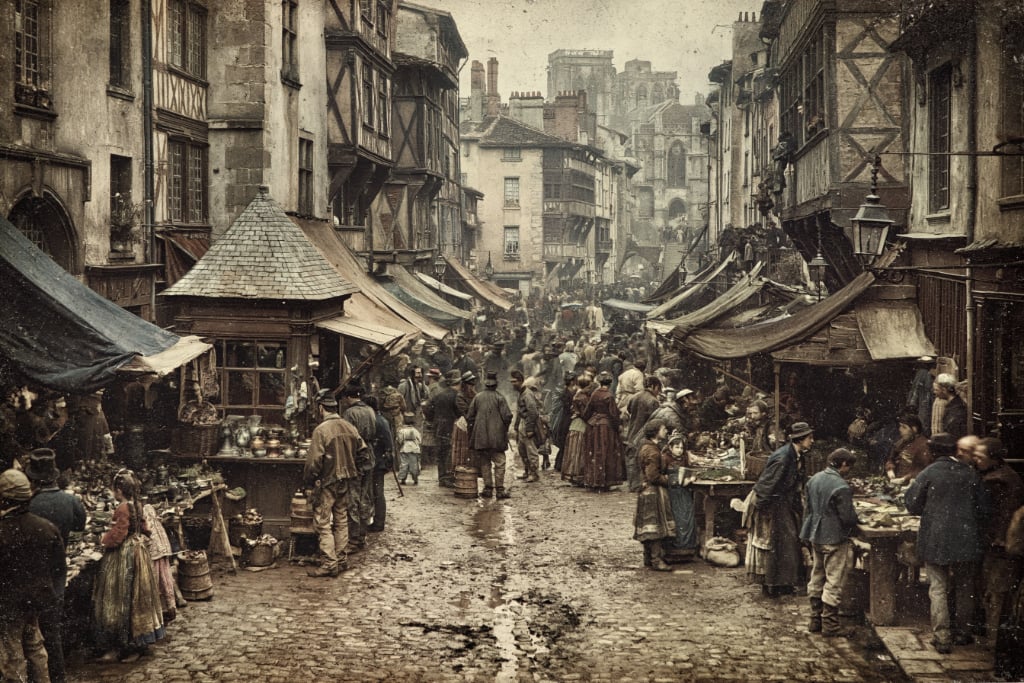
Vienne Saturday Market image 1836

Liturgy for Market Day at Vienne
(where the living bargain and the dead witness)

I. The Uneven World
The stone setts are uneven,
not worn smooth by time,
but accusing.
Each misstep a reminder:
you do not belong here.
Your feet have not learned
this city’s particular limp.

Felreil’s boots slip in the persistent drizzle.
My hems drag through muck
that smells of horses and hunger.
We have left the boat
to stretch our legs,
to breathe something other than coal soot
and the sour sweat of strangers.

But the market breathes back
and its breath is not kind.

II. The Argument at the Bread Stall
A woman and a baker.
The price of bread.
The price of grain.
Failed crops that fill no bellies
but line the pockets of men
who did not starve.

Her voice rises.
His voice rises.
Elbows push and swear.
The crowd tightens
like a fist around a grievance.

I buy camomile, arnica, lavender,
small comforts for small wounds,
while Felreil’s hand closes on my arm,
a warning, flagging
the foreign curl of our pronunciation.

We leave,
but the argument follows,
a ghost that will not stay
at the bread stall.

III. The Ruins That Receive
Narrow paths.
Forgotten gates.
Jasmine climbing stones
that have not felt the sun
since Rome fell.

We slip between ghosts
into the Théâtre Romain,
drizzle softening the edges
of everything that once was sharp.

The amphitheatre receives us
as it receives all:
without judgment,
without welcome,
without warmth.

IV. The Seer in the Ruins
An old man sits where applause used to live.
Life has written its ledger
on his face,
his hands,
the slump of his shoulders.

“I am mad,” he says,
as if introducing himself,
as if everyone else has already decided.

I sit beside him
and tend the sores.
No argument,
no sermon,
only the old work of hands.

“The old ways are dying,” he mutters.
Felreil looks at the broken stone and says,
“Buried, but not dead.”

The old man studies Felreil
as if sight were a blade,
then murmurs,
“I see a dead man walking.”

V. The Poster on the Wall
We walk back toward the river
and the market’s noise thins
into the drizzle’s hush.

And there it is:
AVIS IMPORTANT
RECHERCHÉ PAR LA JUSTICE
AGITATEUR SÉDITIEUX ET DANGEREUX

The words leap from the wall
like an accusation.
The face on the poster is not ours,
not yet,
but it could be.

Brigid does not stop.
Felreil does not look back.
We have learned not to linger
where our faces might be remembered.

Yet the poster follows us.
To the boat,
to the cabin,
to the sleepless night ahead.

VI. For the Watched
Remember the uneven stones
that teach your feet where you do not belong.
Remember the bread-stall argument;
may the woman’s hunger be answered
before the baker’s profit.

Remember the ruins that receive the lost,
and the madman’s eyes,
and the sores,
the thyme and patience
and no questions asked.

Remember the poster on the wall.
Not for its threat,
but for its warning:
run before the law flags your name.

And bless the travellers in drizzle
who carry camomile and fear,
who tend the wounds of strangers,
and keep walking.

That is not sedition.
That is survival.
And survival, in this century,
is revolution enough.


Written as a worksheet and mind-map for Denise’s Six Sentence Story, including the word flag. All previous Liturgies are here. Some images created with Midjourney; all writing is authentically my own original work.©Misky 2006-2026.

18 responses to “2104: The Liturgy”

  1. You even had me reaching for my OED with this one!

    Liked by 1 person

    1. Hmmm … let’s see. Was it stone setts?

      Liked by 1 person

      1. Absolutely. It was the double-t. Never seen set spelled that way before, but then the OED said the double-t variants were all “old English” (which looks like pre-1300) so I don’t feel so ancient today 🤣

        Liked by 1 person

        1. Nope. (laughing) Sett is a type of paving stone, often referred to as Belgian Block. Square-ish granite blocks still used for paving nowadays. https://en.wikipedia.org/wiki/Sett_(paving)

          Liked by 1 person

  2. I think very few people understand what a task survival was in the past. Sometimes I long to experience it for myself. who knows…

    Liked by 2 people

    1. I picked this period of time in Europe for a reason; it was bloody awful. France is about to have its 3rd Revolution (just as violent as the one everyone knows about), mass crop failure of grains and potatoes right across Europe (but worst hit was Ireland), industrial revolution which is changing rural and urban life leaving millions without employment, starving in workhouses. It is not a period of time that I’d choose. (grinning)

      Liked by 2 people

      1. I think I would…..

        Liked by 1 person

        1. A fierce woman.

          Liked by 1 person

          1. No. I just think I am capable of a whole lot more than this life has asked of me.

            Liked by 1 person

            1. Gosh, that comment caught me completely unprepared, and left me thinking.

              Goodnight, Violet. Bedtime here.

              Liked by 1 person

  3. Simply wonderful! Not only am I captivated by your narrative style, which skillfully navigates a world of dreams, fear, and ancient truths, but it’s also the unspoken, because unspeakable, that hovers over the scene. This perfect interplay creates a fascinating depth for me, unfolding the historical events in a highly literary way.

    Liked by 1 person

    1. Thank you. I am so grateful that you see all the levels within these; they are the spine and architecture of the Six Sentence Stories. The parallels between now and then are stark. Revolution, war and famine causing mass movement of people through countries — looking for somewhere that ‘feels’ like home and how these people become less and less welcome as food shortages and employment prospects dwindle. Sound familiar? Things never really change, do they, Friedrich. Again, thank you so much.

      Liked by 1 person

      1. Yes, it’s not surprising that we see so many things alike, not just regarding your great writing. The societal parallel isn’t really striking to me: the pillars are always based on the same foundation: creating latent enemy images, generating pressure and inciting hatred while an “elite” group lines its pockets and rails against others. This is very convenient, because when there’s nothing left to take or distribute, you already have a ready-made enemy image. These days, the revolution isn’t so easy due to the technological capabilities of the puppet masters, but where there’s a will, there’s a way 😉

        Liked by 1 person

        1. By the way, many years ago I created a collage that I think captures the mood of your picture in a very similar way. https://i0.wp.com/zettl.blog/wp-content/uploads/2022/06/collage2.jpg?w=556&ssl=1

          Liked by 1 person

          1. What an extraordinary collage. It a glimpse through time.

            Like

        2. Our generation still had freedom of speech to use back then; right to protest. Even that is throttled in this country. Puppet masters. Pah!

          Liked by 1 person

  4. Most interesting as ever.

    Liked by 1 person

    1. Thank you, Chris.

      Liked by 1 person

Leave a reply to Zettl Fine Arts Cancel reply