
Episode 4: Dead Men Don’t Drown — Liturgy for the Antique Shop
(where the dead linger in the objects they once loved)
I. The Shop That Holds the Past
The antique shop breathes softly,
beeswax and dust holding the warmth of rooms
whose fires went out years ago.
Objects wait for hands that will not be theirs.
Silver has darkened where fingers
no longer polish it; old porcelain
has warmed from white towards ivory,
a colour new china has not yet
lived long enough to learn.
Wood has taken the shine
of palms into its grain.
Everything here has outlived somebody.
Fenella steps inside, feels a peculiar stillness
of things carried through rooms
that no longer stand, placed on tables
long since cleared, lifted by hands
whose absence are part of the object.
Nothing speaks. But nothing is entirely silent either.
II. The Brass Telescope
There is a crystal snowball;
she turns it over, shakes its weather alive,
snow falling upon a house
whose tiny windows never change.
Beside it, a brass telescope,
polished so that the metal shines
brighter than the view it might find.
The brass is warmer where hands held it,
the narrow sections reluctant to slide apart,
as though it has grown accustomed to being closed.
She lifts it to her eye.
The lens gives her nothing miraculous:
the same sea, the same sky,
the same troublesome distance
between the watcher and the watched.
Who looked through it for a ship late home?
Someone finding the moon
because sleep would not come?
The telescope has survived the eye
that once depended upon it.
It does not tell; it only permits
another person to look.
III. The Willow Pattern Dishes
Nearby, willow pattern dishes lean together,
none quite the blue or white they once were.
Age warmed the porcelain towards cream;
the cobalt softened from years of washing,
and in the centre of one plate the glaze
surrendered to the small passages of a knife.
Some are chipped.
One carries a hairline crack
from rim towards centre.
Another has been mended
by someone unwilling to accept
that breaking was the same
as being finished.
That is what age does to an object:
takes away its perfection
and gives it a history instead.
These dishes have held other meals,
heard arguments across tables,
waited beneath crumbs,
received knives and forks
and elbows and ordinary carelessness
of people who believed
there would always be another supper.
The chips are not proof that they were neglected;
they are evidence that somebody kept reaching for them.
IV. The Dogs That Face the Sea
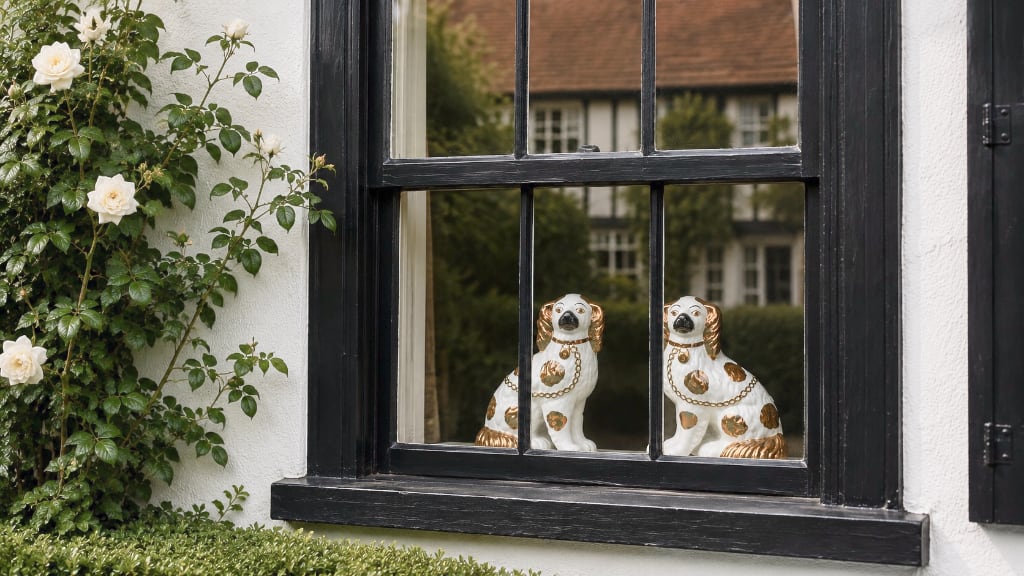
And then, the dogs.
Two Staffordshire spaniels,
white and gold and black-eyed,
their glaze still holding a little light
in a shop crowded with things
whose shine has gone.
They face outward.
Towards the harbour.
Towards the narrow piece of world
where land stops being certain.
Her grandmother’s dogs face the same way.
The shopkeeper follows Fenella’s gaze
and gives her the old explanation:
outward while the man is at sea,
inward when he has come home.
Such a small domestic language.
Two china dogs the direction of their noses
telling a village whether a bed is empty.
Fenella understands that waiting
is a habit long after hope
has ceased to deserve it.
But what if he never returns?
The shopkeeper has no answer.
Neither do the dogs.
They have been given only two directions.
V. For the Objects
For the telescope, may the next eye at its lens find something worth the distance.
For the willow plates, may their warmed porcelain and wounded edges remind us that use is not the enemy of beauty; sometimes it is how beauty acquires a life.
For the dogs facing the sea, may their watching not become a sentence.
For Fenella, walking among the belongings of strangers, may she understand that touching what the dead once touched need not mean carrying what they carried.
Objects remember differently from people.
They keep pressure, warmth, scratches, stains, worn glaze, the polish of hands.
They do not remember names.
Perhaps that is why they can tell the truth
without knowing they have told it.
Written as a worksheet and mind-map for Denise’s Six Sentence Story. All previous Liturgies are here. Some images created with Midjourney; all writing is my own original work.©Misky 2006-2026.


Your comments are always welcome