
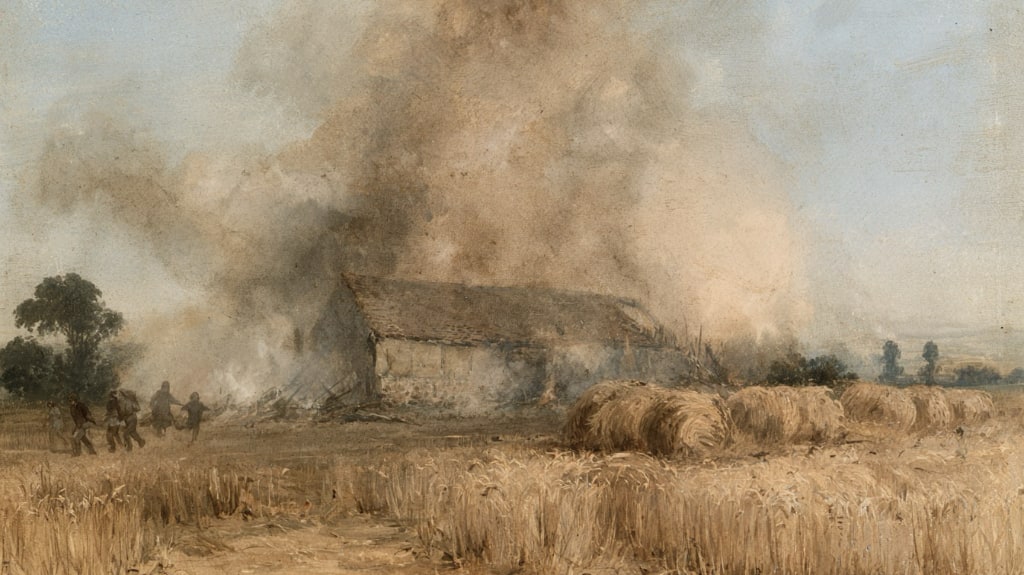
Liturgy for the Burning of Iron
(Sussex, 1838—where the poor refused to starve in silence)
I. The Ledger of Hunger
England asked for more.
Not more work —
the labourers gave that already,
their backs bent to the sickle,
their hands calloused by the scythe,
their winters surrendered
to a season that never paid its debts.
England called for silence.
For gratitude.
For wages that would not keep bread in a child.
It was meant to feel like mercy.
The ledger was simple:
you give your body,
you give your life,
you give your children’s future —
and in return,
the landlord keeps his carriage,
the magistrate keeps his cellar,
the merchant keeps his profit.
They called it order.
II. The Theft Dressed in Iron
Then came the threshing machines.
Progress.
But it was theft dressed in iron.
It swallowed the harvest work,
that labouring families
needed
through winter into spring.
A machine does not need bread.
A machine does not cough in the night.
A machine does not watch its children
grow thin as winter light.
But the labourers —
they needed all of these things.
And the machine took them
without apology,
without explanation,
without even the pretence
of fair exchange.
So the machines were broken.
Not out of hatred for iron,
but out of love for life.
III. The Arithmetic of Rebellion
Barns burned.
Men, women, children took to arms.
Not from wildness —
never from wildness,
but because starvation
entered every cottage
and stood there watching
like a magistrate counting ribs.
Brigid walked among them.
Her soul would not rest
in the suffering.
She handed out not weapons
but witness —
the knowledge that someone saw,
someone remembered,
someone would not let their names
be erased by history’s hungry steam.
The cry rose for bread.
For fair wages.
For the pennies that might keep
life in a body.
And the newspapers named it war.
Named it treason.
As though the poor refusing to starve
were guilty of sedition.
IV. The Lesson Made Public
Then came the arrests.
The prisons.
The lesson made public:
this is what happens
when you touch the machine
that was meant to replace you.
Leaders condemned.
Two sent to the gallows,
hung —
their bodies swinging
as a warning to every cottage,
and hand that had ever dreamed
of breaking free.
After that,
every fire lit, cast
its light toward a noose.
Every whispered word
carried the weight of a rope.
Every shadow in the lane
was a magistrate’s finger
pointing at you.
V. The Flight Before the Noose
Brigid and Felreil fled
before the hangman’s noose caught them.
Not because they were guilty —
guilt is not the question
when the verdict
is already written.
They fled because survival
is not surrender.
Because the labourers of Sussex
taught them something
the gallows could not hang:
that hunger is not a crime,
that starvation is not sedition,
that breaking a machine
is sometimes the only prayer
the body knows.
They fled with the smoke
still in their lungs,
with the names of the hanged
still on their tongues,
with the knowledge
that England would ask for more,
and they would not be there
to give it.
VI. For the Burners
See the broken machines.
May they rust into a mercy
they never offered in life.
See the barns that burned.
May their heat have warmed
a hungry child’s hands.
Remember the hanged men.
May their necks teach us
what justice looks like
when it wears a noose.
Remember Brigid, who walked among the poor
and did not look away.
Remember Felreil, who fled beside her
and never asked if she was sure.
And remember the ones who stayed,
who fed the fires,
who broke the iron,
who refused to starve in silence
even when silence was the only wage
England offered.
The poor refusing to starve
is not sedition.
It is survival.
And survival,
in every age,
is the only revolution
that matters.
Written as a worksheet and mind-map for Denise’s Six Sentence Story. All previous Liturgies are here. Some images created with Midjourney; all writing is authentically my own original work.©Misky 2006-2026.


Your comments are always welcome