
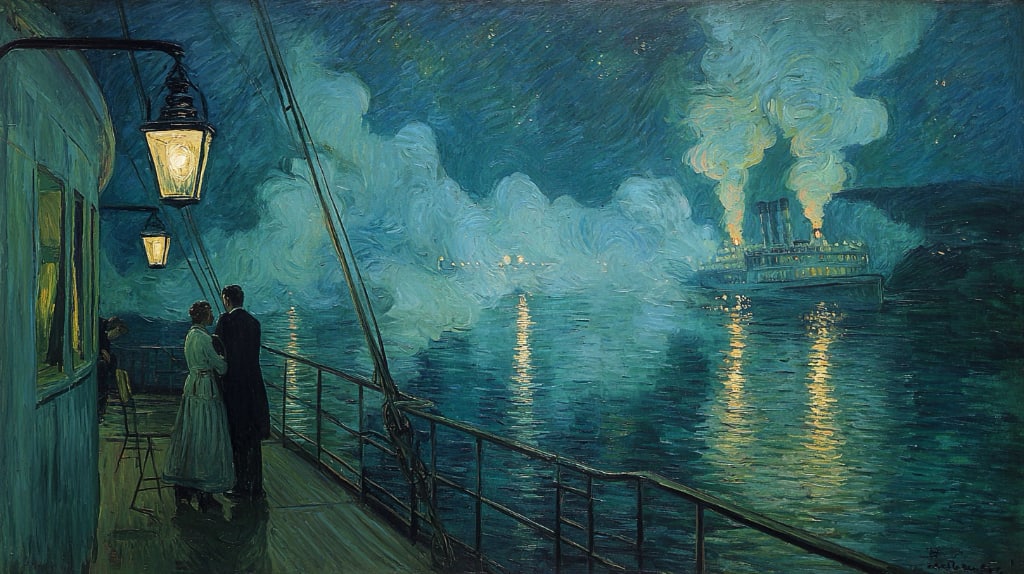
Liturgy for the Mechanical Dark
Night on the Rhône, Half Light and Awake
I. The Weight of Sound
Sound has become a weight.
Not noise—noise is fleeting:
a shout, a clatter; this thing
shuffles marrow in bone.
This is weight:
the engine’s pulse hammering my bones
until sleep feels mechanical,
a function rather than a rest.
Lanterns shake in their brackets.
The floor vibrates through my soles,
up my spine,
into the hinge of my jaw.
I am becoming part of the machine—
not by choice,
but by proximity.
The river has stopped asking permission.
It simply insists.
II. The Smell of Old Things Turned Over
The Rhône gives up its secrets
in the dark;
silt and decay,
things that drowned and were never found,
old grievances stirred from the bottom
by the paddle wheel’s relentless hunger.
Breathing feels like participation now.
Each inhale pulls smoke and grease
into lungs that did not consent
to this communion.
I am breathing the journey.
Becoming the journey.
And the journey
I am learning
has a taste: copper, rot,
and something sweet beneath it all,
the ghost of water
that remembers being clean.
III. The Patience of Darkness
I stand at the rail
until my stomach forgives me,
not because I have earned forgiveness,
but because the river is indifferent
to human suffering.
My breath slows,
matches the water’s measured movement.
Darkness teaches patience better than light:
light asks for action,
for direction,
for seeing.
Darkness asks only that you stay.
And so I stay.
And the river takes my quiet
as permission.
IV. The Kindness of Silence
Felreil stays beside me.
Does not speak.
Does not touch.
Simply stays.
This is kindness,
not the kindness of fixing,
but the kindness of witnessing:
presence without demand,
letting the engine hammer
and the stomach turn
and the dark teach its slow lesson
without interruption.
He does not need to say I am here.
His silence says it better.
V. The Insistence of the Modern World
I understand now,
in the vibrating dark,
in the smell of silt and smoke,
in the patient, wordless presence
of a crow who has seen centuries,
the modern world does not announce itself
with ideas.
It announces itself with insistence.
It asks the body to agree
before the mind is ready.
It hammers agreement into bone
while thoughts are still forming
their objections.
This is how progress works:
not by persuasion,
but by habituation.
You learn to sleep
because sleep is necessary,
not because it is restful.
You learn to breathe smoke
because the alternative
is not breathing at all.
VI. The Cost of Moving South
If motion can be learned this way,
without choice,
without rest,
without sleep,
then the river has taught us
what it will cost
to keep moving south.
Not coins.
Not passports.
Not the provisional papers
warming my pocket.
This:
hammering,
smoke,
this dark that teaches patience
by offering no alternative.
The cost is the body’s surrender
learning to say yes
with muscles and bone
while the mind is still whispering no.
But I stay at the rail.
Felreil stays beside me.
And the river …
it does not care
about the cost.
It only flows.
And so
I learn to flow with it.
VII. For the Mechanical Dark
For the engine and its hammering pulse.
the smoke that fills unwilling lungs,
the silt and the old things turned over,
the river’s rot, its ghost of sweetness.
For the dark that teaches patience,
the silence that stays beside you,
the body that learns
what the mind cannot.
For the cost of moving south:
may it be worth every hammered bone,
every smoke-filled breath,
every sleepless hour at the rail.
For the travellers in the mechanical dark
learning to flow
before they understand the current.
The river does not wait for consent.
Neither does the age we are entering.
But we are learning.
And learning,
in such a world,
is its own kind of courage.
Written as a worksheet and mind-map for Denise’s Six Sentence Story including the word: shuffle. All previous Liturgies are here. Some images created with Midjourney; all writing is authentically my own original work.©Misky 2006-2026.


 It's Still Life
Your comments are always welcome