
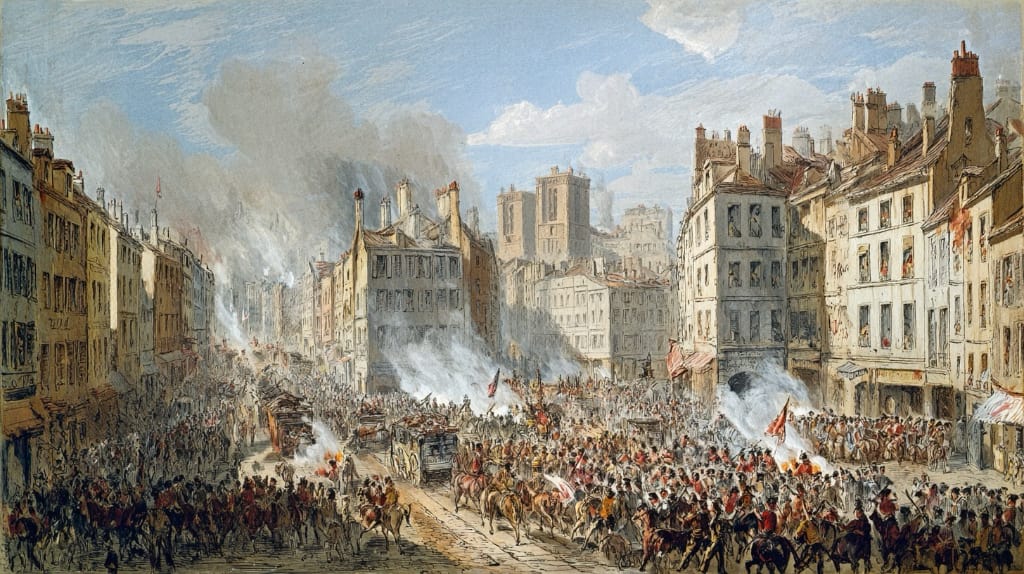
Liturgy for the Looms That Never Stop
(Lyon, 1834, where silk costs more than children)
I. The Sound That Never Ends
It begins before dawn and continues after.
The clack clack clack of wooden shuttles
throwing thread, catching thread,
weaving fabric that will never warm
the hands that made it.
All day. All night. Every day.
The looms do not rest.
They cannot rest.
Because silk does not wait,
and merchants do not wait,
and hunger does not wait,
and the children,
the children sleep on factory floors
with the rhythm of machinery
pounding in their narrow chests.
This is not work.
This is surrender.
The body given over to a god
that does not know their names.
II. The Dust They Breathe
Look at the children.
Their fingers fly through silk cocoons,
unwinding what the worms made,
small hands blurred with speed
because speed is the only mercy
the foreman knows.
They breathe dust all day.
They cough all night.
Cloth becomes lung,
and silk dust settles where breath should.
They die before they grow,
and no loom stops
to mark their passing.
This is Lyon, 1834.
This is civilisation’s bright centre,
where fabric worth a king’s ransom
is made by those who have never worn
a single thread of it.
III. The Pamphlets in the Dark
At night, when looms refuse to relent,
other sounds rise:
the rustle of illegal paper,
the whisper of words that carry
sentences longer than survival.
Justice. Rights. Enough.
Men and women huddle by candlelight,
reading aloud to those who cannot read,
translating hope into language
the overworked and underfed can hold.
The pamphlets say:
You are not beasts. You are not silk.
You are not the thread but the hand that pulls it.
And hands can stop.
Authorities call this sedition.
Workers call it breath.
IV. The Police in the Street
By day, the streets belong to merchants.
By night, they belong to patrols—
men with batons and orders,
men who see gathering and call it a mob,
men who beat first and ask never.
I watch from a doorway
as an agitator is dragged away,
his pamphlet still clutched in his hand,
his face already purple with tomorrow’s bruises.
I feel it in my chest,
that old, familiar pull.
The same pull I felt in the last place,
and the place before that.
The same recognition:
These are my people.
These hungry, beaten, desperate ones.
I know them.
I am them.
V. The Battle Coming
It is in the air.
The inevitable.
You can smell it beneath the river rot,
beneath the dust and the dye and the sweat.
It is the smell of enough.
Enough hunger.
Enough silence.
Enough watching children die
so merchants’ wives can wear
what their children should have eaten.
The battle will come.
Tomorrow. Next week. But it will come,
because when you push the weavers too far,
when you beat the readers in the street,
when you let the children cough themselves to death
on the floors where they sleep—
the looms do not just clack.
They rise.
VI. The Choice of Siding
We know what is coming.
We know which side we stand on.
Not because we chose it,
but because it chose us—
the way the river chooses the sea,
the way hunger chooses the belly,
the way justice chooses the heart
that has seen too much
to look away.
Felreil watches from a doorway,
his black coat still as stone.
He does not ask.
He knows.
He has always known.
“Then we stay,” he says.
Not a question.
Not a warning.
Just a fact.
And I nod,
because some things are simpler
than survival,
because some rights are not written
in pamphlets or laws,
but in the bones of children
who should have lived.
We stay.
For now.
And Lyon—
will never be the same.
VII. For Those Who Choose
Hear the looms and their endless clatter.
Hear the children’s dust-filled lungs.
Bless the pamphlets and hands that pass them;
the readers and the listeners,
the beaten and the unbowed.
Bless those who see their own
in the faces of the hungry
and do not turn away.
And bless the battle that is coming.
Not for its violence,
but for its truth:
that some things are worth fighting for,
and children are always,
always,
among them.
Mind-mapping written for Denise’s Six Sentence Story, including the word “fly”. Some images created with Midjourney; all writing is authentically my own original work.©Misky 2006-2026.


 It's Still Life
Your comments are always welcome